
Showing posts with label review. Show all posts
Showing posts with label review. Show all posts
Friday, 14 December 2012
The Legend of King Arthur - By Class 4L, St Joseph's Primary
Last Saturday, I attended the modern dress version of the myths of Albion, performed by the Saint Joseph Primary School for Boys Players, and directed by a collective who refer to themselves only as ‘The Teachers’.
I had high hopes for this piece: the cast was young, and the venue experimental. In a bold move by the directors, the piece was performed in a fully-functioning school dining hall. A move made especially bold by the fact that there were no wings, and actors, while not onstage, were forced to sit in front of the audience, cross-legged, and change costumes out in the open. Not that this happened often; it was rare that there were any fewer than ten actors onstage at any point. While I think that equal opportunities initiatives are to be applauded, I do wonder whether the decision to take on monophobic actors in some way compromised the artistic integrity of the piece; the fact that players tended to clump together in groups of at least four meant that several were obscured for the entire duration of the play and this, coupled with the fact that most never spoke, left me with the impression that the cast was somewhat bloated for the modest demands of the script.
The set design was minimal - one suspects to match the lighting, a monotonous binary of ‘on’ and ‘off’.
This was an intensely physical piece of theatre; the company was in constant motion - tugging sleeves, straightening crowns, and rubbing their noses - which conveyed a powerful, visceral sense of nervous energy. One really felt immersed in the world they had created, steeped in anxiety over the fate of the future king, and of Albion itself. To the company’s credit, this movement was maintained consistently throughout the piece. Although quite why this nervousness persisted after the young King Arthur ascended to the throne is a mystery. While this attention to physicality should be lauded, it was not without its flaws: efforts to break the fourth wall by intermittent eye contact with, and waving at, members of the audience felt confusing, and one was left with the impression that the director was trying to be just that bit too clever.
This was a highly experimental piece; in an audacious move, the directors chose to abandon linear storytelling in place of a form of semi-improvisation, giving the cast a script to learn, but allowing the actors to deliver lines in the order that they feel appropriate on the night. Example:
Arthur “I’ve done it!”
Kay “He’ll never be able to do it”
Arthur “Can I have a go?”
Kay “It’s a sword!”
Another innovation came in the form of Pinter-esque silences, ended by a detached female voice engaging actors in call-and-response. The decision to have an all-male cast, but an apparently prescient female voice reading characters’ thoughts and voicing them before they can voice the lines themselves, is obviously a bold political statement. But what is it saying?
The musical numbers felt forced and under-rehearsed, with a good fifty percent of the cast mouthing at least some of the time. Instead of acting synergistically, enhancing the narrative drive, the flow felt somewhat interrupted as songs were placed at the peaks of action. See, as exemplar, the somewhat incongruous number “Castle of Camelot” (consisting of that phrase sung repeatedly to the tune of the first line of “Jesus Christ, Superstar”, for three and a half minutes). Soloists seemed uncomfortable, keen to finish their songs as soon as possible, often starting their pieces several bars prematurely and ignoring bridges in order to race to the end of their allotted lyrics.
To conclude, it was not quite the tour de force that I was expecting. I can see why they only booked the venue for a single performance.

Saturday, 31 July 2010
I’m thinking of a TV show. Can you guess what it is?
The protagonist is a slim man with superhuman intellect. He travels, accompanied by an assistant who tempers his cold logic with empathic insight. He solves mysteries, wears a trench coat.
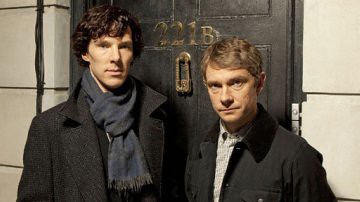
On first examination of the facts, Sherlock, the latest iteration of the story of Watson and Holmes, shares much common ground with the BBC’s favourite Time Lord. Further parallels may be drawn; the series is written by Steven Moffat and features Mark Gatiss. It delivers well-scripted, well-cast entertainment to a discerning audience. Recently, the franchise’s image had been updated.
You might have suspected that Sir Arthur Conan Doyle’s super-sleuth was harboured with a faulty Chameleon Circuit. Since Holmes’ iconic deerstalker cap first appeared in Sidney Paget’s illustrations in 1891, it has remained firmly affixed to his head. Like the British Government’s debt of £900 billion and that tiny smudge in the corner of your glasses, some things are hard to shift.
But the Doctor is free to traverse time periods; why should Holmes be tethered to the gas-lit turmoil of Victorian London? In an article for the Radio Times, Moffat wrote that “Doyle was writing fast-paced, contemporary detective thrillers – he wasn’t wasting time on what you could see from your own window. It was about story, surprise and jokes and of course those mind-bending deductions. He wasn’t – to state the obvious – writing a period piece.”
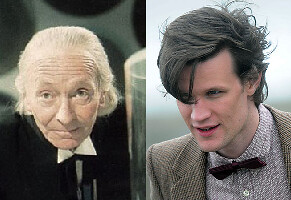
Moffat and Gatiss aren’t heretics – they’re renovators. While the Victorian aesthetic is ephemeral, the story’s appeal is perennial. The character of The Doctor had been been reinvented and re-dressed eleven times! Few would argue that his transformation from William Hartnell to Matt Smith has defiled the concept. Sherlock may not be a son of Gallifrey, but he was due a regeneration.
Whereas The Doctor relies on questionable quasi-science to resolve plots, Sherlock awes the viewer with a dazzling display of analytical acumen. His seemingly infinite capacity for knowledge and detail leaves the viewer stunned, the ratings high and the case solved.
Under the watchful eye of Moffat, Holmes has achieved a stunning resurgence. (Without the use of a sonic screwdriver.)
On first examination of the facts, Sherlock, the latest iteration of the story of Watson and Holmes, shares much common ground with the BBC’s favourite Time Lord. Further parallels may be drawn; the series is written by Steven Moffat and features Mark Gatiss. It delivers well-scripted, well-cast entertainment to a discerning audience. Recently, the franchise’s image had been updated.
You might have suspected that Sir Arthur Conan Doyle’s super-sleuth was harboured with a faulty Chameleon Circuit. Since Holmes’ iconic deerstalker cap first appeared in Sidney Paget’s illustrations in 1891, it has remained firmly affixed to his head. Like the British Government’s debt of £900 billion and that tiny smudge in the corner of your glasses, some things are hard to shift.
But the Doctor is free to traverse time periods; why should Holmes be tethered to the gas-lit turmoil of Victorian London? In an article for the Radio Times, Moffat wrote that “Doyle was writing fast-paced, contemporary detective thrillers – he wasn’t wasting time on what you could see from your own window. It was about story, surprise and jokes and of course those mind-bending deductions. He wasn’t – to state the obvious – writing a period piece.”
Moffat and Gatiss aren’t heretics – they’re renovators. While the Victorian aesthetic is ephemeral, the story’s appeal is perennial. The character of The Doctor had been been reinvented and re-dressed eleven times! Few would argue that his transformation from William Hartnell to Matt Smith has defiled the concept. Sherlock may not be a son of Gallifrey, but he was due a regeneration.
Whereas The Doctor relies on questionable quasi-science to resolve plots, Sherlock awes the viewer with a dazzling display of analytical acumen. His seemingly infinite capacity for knowledge and detail leaves the viewer stunned, the ratings high and the case solved.
Under the watchful eye of Moffat, Holmes has achieved a stunning resurgence. (Without the use of a sonic screwdriver.)
Subscribe to:
Posts (Atom)